
Google Ads vs. Facebook Ads: Which One Actually Gets You Customers
A printing and graphic design shop owner posted in r/googleads with a common question: new to digital marketing, a limited budget, and no idea whether to start with Google Ads or Facebook Ads.
The replies split into two camps, and both were right. One said start with Google, because someone typing “business card printing near me” is already close to buying.
The other said start with Facebook, because a visual business like printing lives on the kind of scroll-stopping creative a search ad can’t show.
Neither camp was wrong. They were answering two different questions, and that is the actual answer to “Google Ads vs Facebook Ads”: it depends on what your customer is doing at the moment they find you.
Below is the real difference in intent, the actual cost numbers (a Google Search click runs roughly four times what a Facebook click costs, and that fact alone misleads more advertisers than it helps), and how the targeting works underneath.
It also covers which platform to start with for your kind of business, and why the accounts with real budget behind them stop treating this as an either/or question by month three.
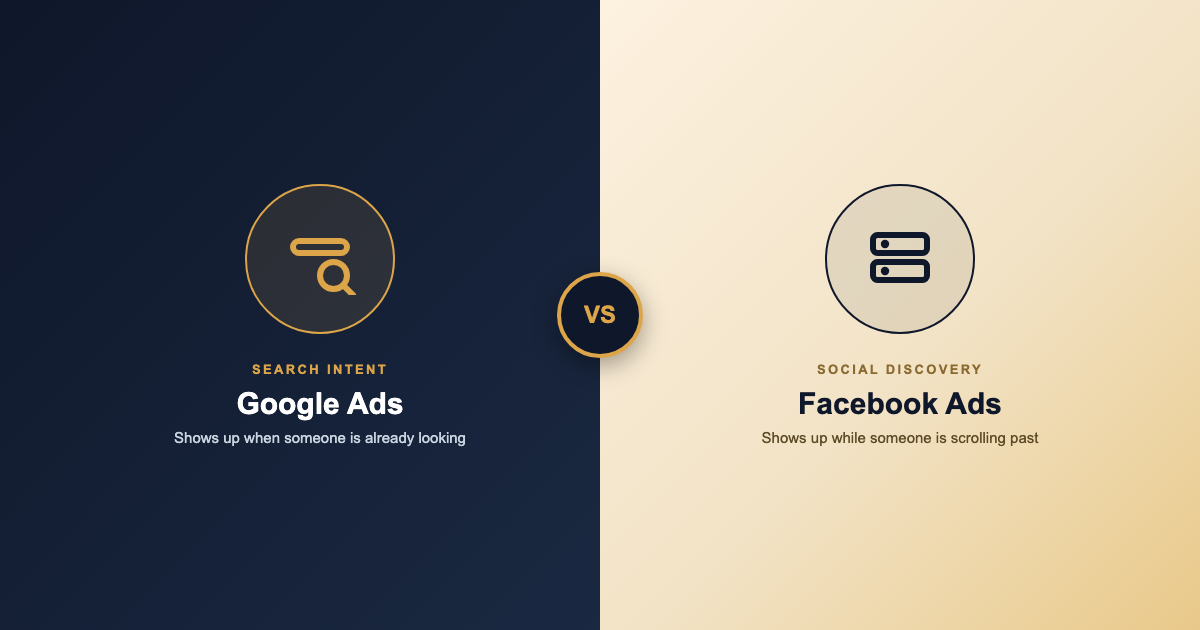
Google captures demand. Facebook creates it.
Every comparison of these two platforms comes back to one distinction, and once it clicks, most of the follow-up questions answer themselves. Google Ads is pull marketing. Facebook Ads is push marketing.
Someone searching Google already has a need; the ad meets them there. Someone scrolling Facebook has no need in mind at all; the ad has to interrupt them and create one.
As one agency owner put it in that same Reddit thread: pull marketing plays into existing demand, push marketing has to create it.
That is exactly why a brand-new advertiser usually sees a decent return faster on Google, presuming the demand is actually there to capture.
Why Google usually wins the first dollar
That is why the standard advice for a new advertiser with a real search-intent product is to start with Google. Not because Facebook is worse, because Google requires less to work.
If people already search for what you sell, Google Ads finds them without you having to invent a reason for them to care. Facebook demands a real creative budget in return.
Text and a keyword list can carry a Google Search campaign a long way. Facebook punishes the same laziness fast: stale creative gets quietly ignored within days, no matter how tight the targeting is underneath it.
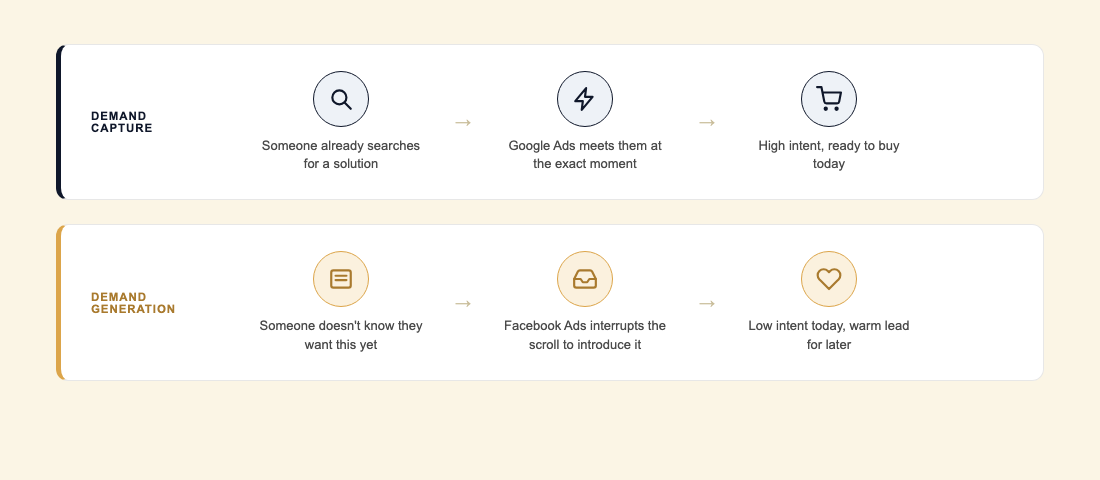
Key Takeaway
Google Ads answers a question someone already asked. Facebook Ads asks a question someone has not thought of yet. The cost differences, the creative demands, and the targeting mechanics all follow from that one fact.
The cost gap looks bigger than it is, until you count what happens next
Facebook clicks are cheap. Google clicks are not. Cross-industry benchmarks put average Google Search cost per click somewhere around $2.70 to $3.10, and in competitive verticals like legal or home services it runs well past that.
Facebook’s average cost per click sits closer to $0.62 to $0.72, with an average CPM around $11.54. On a pure cost-per-click basis, Facebook wins by roughly four to one.
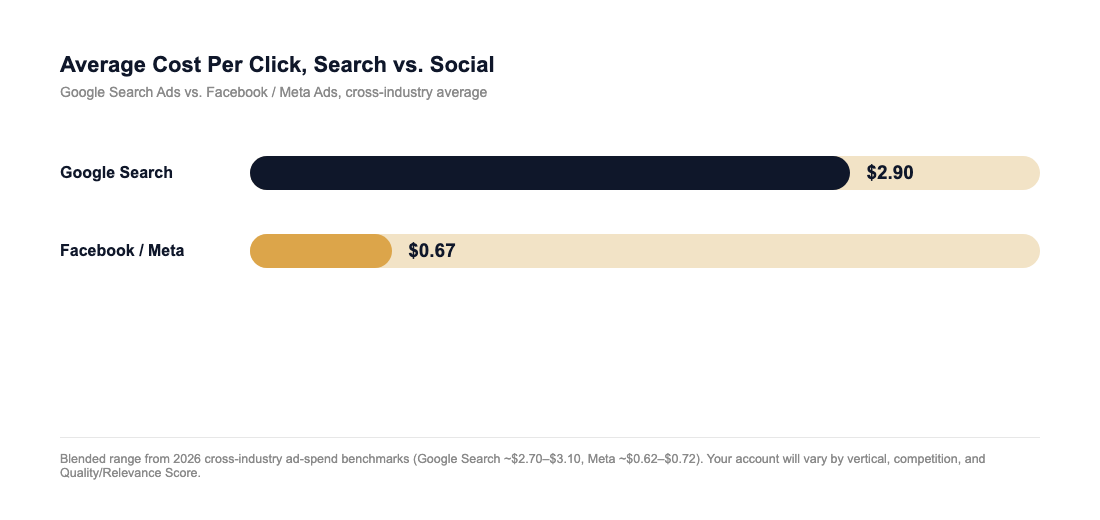
What $2.90 vs. $0.67 actually buys you
Cost per click is not the number that pays your bills. Cost per customer is. Google Search ads convert at a materially higher rate, averaging around 4.4% directly from the ad.
That is the tradeoff nobody puts in the headline: you pay more per click for traffic that has already decided it wants a solution, versus paying less per click for traffic you still have to convince.
A $2.90 click converting at 4.4% and a $0.67 click converting at a fraction of that can land at a similar cost per customer, or either one can win outright, depending on your offer, your creative, and how well your landing page closes.
| Metric | Google Search Ads | Facebook / Meta Ads |
|---|---|---|
| Avg. cost per click | $2.70 – $3.10+ | $0.62 – $0.72 |
| Avg. CPM | Varies by keyword and network | ~$11.54 |
| Avg. conversion rate | ~4.4% (direct, search) | Lower direct; strong for in-platform lead forms |
| Creative demand | Low; keywords and text can carry it | High; fresh video/image or ad fatigue sets in within days |
Why “zero conversions” almost never means the platform failed
Below roughly 30 conversions, a Google Ads test is not giving you a verdict, it is giving you noise.
One paid-search consultant, after reviewing more than thirty client accounts in a single year for a Reddit thread on r/googleads, found that the median account gets 62% of its conversions from just the top 1% of search terms by spend.
That is worth internalizing before you kill a “failing” Google campaign at $200 spent: price out your highest-volume, most obviously relevant search terms first. If nobody is searching those, the platform mismatch is real.
If they are, the campaign probably needs more data, not a different platform.
What’s in it for you: knowing this before you spend saves you from the single most common early mistake we see.
That mistake is judging Google Ads a failure after a few hundred dollars and two weeks, when the actual problem was under-testing, not a bad platform.
Keywords tell you what people want. Interests guess at who might want it.
What Google Ads actually targets: the search term
Google Ads targets intent directly: the exact words someone typed into a search bar, plus location, device, and time of day.
It is a blunt instrument in the sense that it cannot tell you much about the person beyond what they searched, but that one signal is enormously strong. Nobody types “emergency plumber open now” out of idle curiosity.
What Facebook Ads actually targets: the person
Facebook targets people: demographics, stated interests, page follows, behavior on and off the platform, and increasingly, lookalike audiences built from your existing customer list. That is a richer profile of the person, but a weaker signal of the moment.
Someone in your target demographic who follows three of your competitors might be six months from buying, or might never buy at all. Facebook’s targeting tells you who is plausible, not who is ready.
Where retargeting overlaps both jobs
Retargeting is where the two overlap, and where a lot of the platform-versus-platform framing breaks down.
A visitor who searched a keyword on Google, clicked through, and left without converting can be retargeted on Facebook a day later with the exact product they viewed.
Search intent captured, then re-engaged with a lower-cost visual nudge; that sequence is one of the more reliable combinations in paid media, and it is not really “Google vs Facebook” at all.
It is Google, then Facebook, doing two different jobs in the same funnel.
The right platform depends on what your customer is doing when they find you
A rough starting bias, sorted by business type. Not a rule; plenty of dentists run great Facebook campaigns and plenty of ecommerce brands live on Google Shopping.
Use the table to decide where your first dollar goes, then let the data move you, not the category.
| Business type | Start with | Why |
|---|---|---|
| Urgent services (plumbers, locksmiths, lawyers) | Google Ads | High-intent, time-sensitive searches convert fast; nobody scrolls Facebook mid-emergency. |
| Ecommerce, visual or impulse products | Facebook/Instagram first | The product needs to be seen before it is wanted; add Google Shopping once demand exists to capture it. |
| Local services (salons, gyms, restaurants) | Both, different jobs | Facebook builds the local audience; Google Search catches the “near me” moment once it exists. |
| B2B / SaaS | Google Ads (Search) | Buyers self-educate through search; Facebook’s B2B targeting is weaker outside niche communities. |
| High-ticket purchases (real estate, education) | Both, sequenced | Facebook builds awareness and captures early leads; Google Search catches people once they are comparing options. |
| Brand-new business, no customer list yet | Facebook/Meta | Cheaper learning phase, and there is no retargeting audience yet for Google to work with. |
| Agencies and freelancers | Google Ads (Search) | Prospects usually search by service plus location; Facebook awareness plays work as a slower, secondary layer. |
Running both is not hedging, it is the actual playbook
By the time an account has real budget behind it, the “Google or Facebook” framing mostly disappears.
The pattern shows up across DTC brands, local service businesses, and B2B alike: Facebook or Instagram introduces the brand to people who did not know they had the problem yet.
Google Search or retargeting catches them once they are ready to compare and buy.
Facebook fills the top of the funnel. Google closes what is already warm.
Zero conversions on a new Google Search campaign is almost never a platform verdict. Below roughly thirty conversions, you have noise, not a verdict.
The Ardent Blogger
Pair it with what you’re already doing in organic search
If you are already investing in organic search alongside paid, the two compound instead of compete.
We have written before about checking real keyword search volume before you build a campaign around a term nobody is actually searching; that same research doubles as your Google Ads keyword list, so it is not wasted effort either way.
Where a second pair of eyes earns its keep
This is also the point where most accounts benefit from a second pair of eyes, not because the platforms are complicated to turn on, but because the budget split between them is where the real money gets made or wasted.
That is the core of our paid search and PPC management work: not picking a winner between Google and Facebook, but building the sequence and reallocating budget as the data comes in.
The short version
- Google Ads: best for existing, searchable demand. Higher CPC ($2.70–$3.10+), higher direct conversion rate (~4.4%).
- Facebook Ads: best for creating demand from scratch. Lower CPC ($0.62–$0.72), needs constant fresh creative.
- New business, urgent-need product, tight budget: start with Google.
- New business, visual or impulse product, no existing demand: start with Facebook.
- Established budget: run both, sequenced. Facebook builds awareness, Google captures and retargets.
Back to the printing shop
That r/googleads thread never really got resolved, the way most “which platform” threads do not, because the honest answer requires information the original post did not include.
That missing information: how many people are actually searching for printing and design services in that shop’s area, and whether the shop has creative worth showing to people who are not searching yet.
Twenty minutes in a free keyword tool answers the first question. A phone camera and an afternoon answer the second. The platform choice was never really the hard part.
Every dollar spent chasing the “right” platform is a dollar not spent finding out what your actual customers do before they buy. That is the only research that matters here, and it is the one most businesses skip.
Ready to Stop Guessing Between Google and Facebook?
Tell us your product, your budget, and your customers. We will tell you where the first dollar should go.
Quick answers
Is $20 a day good for Google Ads?
For most local service businesses, yes, as a starting test budget. $20 a day is roughly $600 a month, which in a moderately competitive vertical buys somewhere between 100 and 200 clicks.
That is usually enough to identify your best-performing keywords within four to six weeks, though not enough yet to fully escape the noise zone in every ad group.
Treat it as a learning budget, not a growth budget.
Do Google Ads work better than Facebook Ads?
Neither works better in general; they work better for different situations. Google Ads outperforms when people already search for what you sell.
Facebook Ads outperforms when you need to create interest in a product people do not yet know they want. Judge “better” by conversion rate for your specific offer, not by platform reputation.
How much does Facebook Ads cost vs Google Ads?
Facebook’s average cost per click runs around $0.62 to $0.72, roughly a quarter of Google Search’s average of $2.70 to $3.10. Facebook’s average CPM sits near $11.54.
The lower click cost does not automatically mean a lower cost per customer, since Google Search traffic converts at a higher rate on average, around 4.4%.
Are Google Ads really worth it?
For a business with real, searchable demand, yes. The clicks cost more, but they arrive from people already looking for a solution, which is why Google Search converts at roughly 4.4% on average.
Businesses that call Google Ads “not worth it” usually spent too little to get past the noise floor described above, or skipped keyword research entirely.
Can I run Google Ads and Facebook Ads together?
Yes, and for any business past the earliest testing stage, this is usually the right move rather than an either/or choice.
The common pattern: Facebook or Instagram introduces your brand to people who do not know they have the problem yet, and Google Search or retargeting catches them once they are actively comparing solutions.
Run both with distinct jobs, not as duplicates of the same campaign.

The Ardent Blogger writes and edits every post on this blog, covering SEO, content strategy, and paid search for small business owners who would rather grow their business than manage six ad accounts alone. 10+ years turning “which platform should I even use” into a working strategy.
Subscribe to learn more about paid search and SEO
We only email you when there’s a new post worth reading. Unsubscribe anytime.
The Ardent Blogger
Writer-led SEO and paid media strategy for small business owners who would rather run their business than manage two ad platforms alone.
Share
Table of Contents
Free Strategy Call
Tell us your goals and get a paid media plan back within one business day.
Most Popular Posts
Want a Paid Ad Strategy That Actually Converts?
- That's what the free call is for.
- Tell us the goal; we'll recommend the platform mix that gets you there.
- No pressure, no jargon, just a plan.
Get a Recommendation
Tell us a bit about your goals and we'll follow up within one business day.